Fertility and relationships: what are we creating together?

What happens to the space between two people when the future enters the room?
A couple is always creating something.
Sometimes that creation is visible: a home, a family, a shared life, a set of routines and memories.
But long before any of those things exist, two people are creating something less tangible between them.
A language. A private world. An idea of us.
There are the things we explicitly agree on, but also the things we never quite say. The assumptions we make about where the relationship is going. The futures we quietly imagine. The roles we begin to occupy for one another. The versions of ourselves that become possible — or impossible — in the presence of this particular person.
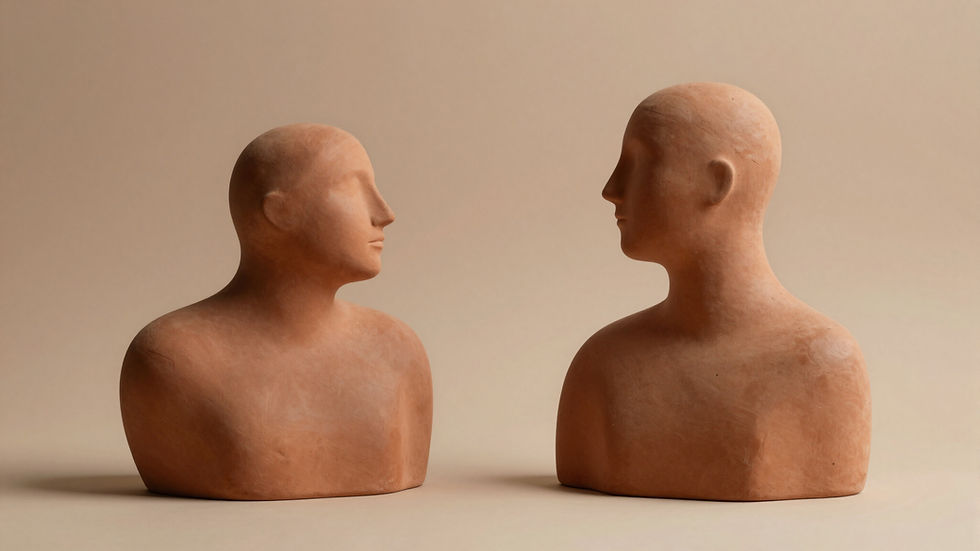
Psychoanalytic couple thinking sometimes describes this as a creative couple space: the psychological space between two people in which difference can be tolerated and something genuinely new can emerge.
Not mine.
Not yours.
Something ours.
And fertility has an extraordinary capacity to enter that space.
Sometimes gently.
Sometimes long before a couple expected it to.
Sometimes with considerable force.
THE THIRD THING BETWEEN TWO PEOPLE
At the beginning of a relationship, the future can remain wonderfully undefined.
We might know that we love someone without yet knowing where we will live in five years. We might imagine children without having decided when. We might talk about marriage, or not talk about it at all, while still carrying private assumptions about what will eventually happen.
There can be something creative in that openness.
The couple is still becoming.
Psychoanalytic thinking is particularly interested in our capacity to tolerate this kind of uncertainty: to remain in contact with another person without immediately needing difference, ambiguity or the unknown to disappear.
Mary Morgan, writing from the Tavistock tradition of couple psychoanalytic psychotherapy, links the idea of the creative couple with a capacity to manage difference and otherness — to allow two separate minds to remain in relationship without one having to absorb the other. She also draws on the psychoanalytic idea of negative capability: our capacity to remain with uncertainty without rushing prematurely towards certainty.
This matters enormously when we begin thinking about fertility.
Because fertility introduces a third thing into the couple.
Perhaps it is not yet an actual child.
It may simply be the idea of a child.
The possibility.
The question.
Do we want one?
When?
With each other?
What if one of us is ready before the other?
And suddenly something that could previously remain relatively abstract begins to acquire time.

WHEN FERTILITY AND RELATIONSHIPS MEET TIME
Fertility preservation makes this particularly complicated.
Someone may begin thinking about freezing their eggs without actually wanting a baby now.
That distinction is enormously important.
I want to preserve the possibility of motherhood is not the same statement as I want us to have a baby now.
And yet, inside a relationship, they can easily become confused.
For the person considering egg freezing, fertility preservation may represent an attempt to create more psychological room.
I don't want biology to force a decision before I am ready.
I don't know what my life will look like yet.
I want to protect an option.
For a partner, however, the same decision might be experienced very differently.
It might sound like:
Are you telling me you want children with me?
Or:
Are you preparing for a future without me?
Or:
Does this mean I need to decide now?
Or even:
Why isn't our relationship enough to make this question simpler?
None of those meanings necessarily belong to the medical procedure itself.
They belong to the relationship.
Research into social egg freezing reflects some of this complexity. Qualitative studies have found that decisions to freeze eggs are frequently bound up not simply with careers or reproductive planning, but with relationships, difficulty finding the right partner, fear of “panic partnering”, imagined motherhood and the wish to preserve possibilities while the circumstances for parenthood remain uncertain.
So fertility preservation may preserve something biologically.
Psychologically, however, it can also expose something.
It can bring into conversation a future the couple had previously been able to leave undefined.
WE MAY NOT BE TALKING ABOUT THE SAME FUTURE
One of the most difficult discoveries in a relationship is that two people can love one another and still be imagining different futures.
Or perhaps the same future on very different timelines.
One partner says:
I want children, just not yet.
The other hears:
You don't want children with me.
One says:
I need to think about freezing my eggs.
The other hears:
You are making plans independently of us.
One says:
I don't know if I'm ready.
The other hears:
You may never choose me.
These moments can become surprisingly charged because the conscious conversation is rarely the whole conversation.
Underneath questions about egg freezing, fertility testing or when to start trying may sit much older anxieties about dependency, abandonment, being chosen, being trapped, losing freedom, becoming like our parents, or discovering that the person we love cannot give us the future we had unconsciously imagined with them.
This is one of the contributions psychodynamic thinking can make.
Rather than asking only “What decision should this couple make?”, we can also become curious about:
“What has this decision come to mean between them?”
CREATIVITY REQUIRES DIFFERENCE
It is tempting, particularly around fertility, to believe that a healthy couple should want the same thing at the same time.
But two separate people rarely develop in perfect synchrony.
One may feel urgency while the other needs time.
One may experience fertility preservation as reassuring while the other experiences it as frightening.
One may want information. The other may avoid it.
One may already be imagining a child while the other is still trying to understand what becoming a parent would mean.
The difficulty is not necessarily the difference itself.
The difficulty is what the couple does with it.
A creative couple space does not require two people to become identical. In psychoanalytic couple thinking, creativity depends partly upon the ability to recognise the partner as a genuinely separate person — someone whose mind cannot be completely controlled, predicted or made the same as our own.
That sounds straightforward until the subject is something as consequential as fertility.
Because when time feels limited, difference can become frightening.
I need you to know.
I need you to decide.
I need you to want what I want.
The understandable wish for reassurance can gradually become a demand that uncertainty disappear.
And the couple can lose the very space in which thinking together might have been possible.
WHEN THE CONVERSATION BECOMES A TEST
Fertility conversations can therefore become tests without either partner consciously intending them to.
Would you freeze embryos with me?
When do you think you'll be ready?
Do you actually want children?
If I froze my eggs, how would you feel?
These may be genuine questions.
But sometimes there is another question underneath:
Do you choose me?
And when that question becomes too frightening to ask directly, we may look for certainty through practical answers.
A timeline.
A promise.
A clinic appointment.
A number.
The conversation then becomes less about thinking together and more about obtaining reassurance.
This can place both partners in difficult positions.
One feels that they must obtain certainty because time matters.
The other feels that anything less than certainty will cause pain.
And gradually there is less room for either person's ambivalence.
Yet ambivalence is not necessarily evidence that a relationship is wrong.
We can want a child and fear becoming a parent.
Want commitment and fear dependence.
Want more time and simultaneously fear losing it.
Want fertility preservation and resent having to think about fertility at all.
Love somebody deeply and still not know exactly what the future with them should look like.
Maturity is not the absence of these contradictions.
It may lie partly in our ability to hold them without immediately forcing one side to win.
WHAT HAPPENS TO DESIRE?
This is also where sexual desire becomes interesting.
When fertility enters a relationship, sex can begin to carry much more than sexuality.
It may become evidence of commitment.
Evidence of reproductive potential.
Evidence that the relationship is still alive.
Or eventually, if a couple begins trying to conceive, something timed and productive.
Sex can move from:
What might happen between us?
to:
What are we trying to make happen?
Research suggests that infertility and fertility treatment can affect sexual desire, functioning and satisfaction for both women and men.
But a psychodynamic perspective invites another question.
What happens to desire when the creative space becomes crowded by outcome?
Eroticism usually needs some freedom from usefulness.
A kiss does not need to achieve anything.
Sex does not necessarily need to produce anything.
Desire can move unpredictably between two people.
But fertility introduces purpose.
Timing.
Measurement.
The imagined child.
The future.
Sometimes the problem is not simply that somebody has “lost their libido”.
There may be very little room left for desire to be purposeless.
FERTILITY PRESERVATION CAN CREATE SPACE — AND FILL IT
This is one of the paradoxes of egg freezing.
Fertility preservation is often described as buying time.
And for some people, psychologically, it may genuinely create breathing room.
But freezing eggs cannot freeze the emotional life surrounding them.
The existence of frozen eggs may alter how somebody thinks about dating, partnership, reproductive timing or future motherhood. Research with women who have undergone elective egg freezing suggests that the procedure can shape romantic expectations and interactions with potential partners rather than simply removing fertility from the dating equation.
So technology can widen possibilities without resolving what those possibilities mean.
There may still be questions about whose child is imagined.
Whether a partner wants children.
Whether eggs might eventually become embryos.
Whether the relationship will last.
Whether motherhood will happen with somebody, alone, through donation, or perhaps not at all.
That does not make fertility preservation unsuccessful.
It simply reminds us that biological time and psychological time are not the same thing.
Medicine can preserve an egg.
It cannot preserve a relationship in its current form.
Nor can it decide what two people will eventually create together.
THE COUPLE AS A PLACE WHERE SOMETHING NEW CAN EMERGE
Perhaps this is where the idea of the creative couple becomes most useful.
A relationship does not have to begin with two people already knowing the answer.
Sometimes the work of being a couple is precisely the work of discovering something that neither person could have decided alone.
Not through one person surrendering.
Not through the other forcing certainty.
But through making enough room for two realities to exist.
This matters urgently to me.
and
I am frightened of being rushed.
I want to preserve my fertility.
and
I don't yet know what parenthood means for us.
I imagine having a child with you.
and
I need to remain a separate person while we think about that.
A couple capable of holding those statements has not solved fertility.
But something important is happening.
They are thinking.
Together.
That may be one of the most creative things a relationship can do.
A QUESTION TO CARRY WITH YOU
When fertility begins occupying more space in a relationship, perhaps the question might be:
What is this bringing up between us — and can we remain curious about what each of us is imagining before we demand an answer?
Because the future of a relationship is not only something a couple plans.
It is also something they create between them.
And sometimes protecting that creative space means allowing love, desire, fear, urgency, uncertainty and difference to exist in the same room.
Not indefinitely.
But long enough for something genuinely shared to emerge.
SOURCES AND FURTHER READING
Morgan, M. “Triangular Dynamics and Triangular Space.” Psychoanalytic Dialogues, 2021. Morgan considers creative couple relating in relation to triangular space, difference, otherness and the capacity to tolerate uncertainty.
Ruszczynski, S. “Notes towards a psychoanalytic understanding of the couple relationship.” Psychoanalytic Psychotherapy, 1992. A Tavistock-based account of unconscious processes within couple relationships and their potential for development or psychic stagnation.
Tarsh, H. & Bollinghaus, E. “Shared unconscious phantasy: Reality or illusion?” Sexual and Marital Therapy, 1999. Explores the psychoanalytic concept of shared unconscious fantasy within the couple relationship.
Leon, I.G. “Understanding and treating infertility: psychoanalytic considerations.” Journal of the American Academy of Psychoanalysis and Dynamic Psychiatry, 2010. Explores infertility through psychodynamic perspectives including identity, self-esteem, developmental aspirations and interpersonal experience.
Baldwin, K. and colleagues. “Running out of time: exploring women's motivations for social egg freezing.” Journal of Psychosomatic Obstetrics & Gynecology, 2019. Qualitative research identifying reproductive timing, partnership, fear of panic partnering and future regret among motivations for egg freezing.
“Social egg freezing, dating and the (unequal) politics of reproductive ageing.” Qualitative research examining how egg freezing and reproductive ageing can shape women's experiences of dating, partnering and imagined family formation.
Evidence checked: August 2026.
Venus of Now provides general education and reflection. This article is not personalised medical, psychological or relationship advice and does not replace consultation with an appropriately qualified professional.

Comments